



How AI Agents Actually Work Under the Hood
Most people cannot explain the difference between a chatbot and an AI agent, even though they use both every week. Here is the short version. AI agents are language models wrapped in a loop that lets them plan, act, check their own work, and change course when something breaks. A chatbot answers and waits. An agent decides what to do next.
That single difference is the whole story. Once you see the loop running inside, the hype gets quieter and the engineering gets clearer. So let me show you what actually happens when an agent runs, where it falls apart in real systems, and how to spot a real agent hiding behind a marketing label.
What is the difference between an AI agent and a chatbot?
Use one quick test. If a task is autonomous, recurring, and reviewable, it is a job for an agent. If it needs your judgment in the moment, happens only once, or has no clear way to check the result, you just want a prompt.
Watch the difference in practice. “Write me a LinkedIn post” is a prompt. You give one instruction and get one answer back. Now compare it to this: watch my industry every Monday, find the three best stories, study my old posts, draft a new one in my voice, and schedule it for Tuesday.
That second instruction is an agent. It runs on its own and makes a chain of decisions without you in the loop. I broke down that shift in detail in how AI agents turn prompts into full workflows. The model in the center is identical. What changed is who makes the decisions.
Think of it like driving. A prompt is a student driver. You stay alert and correct every turn. An agent is a hired driver. You give the destination and sit in the back while it handles the route, the traffic, and the hundred small choices in between.
What is actually running inside an AI agent?
At the core of every agent sits a plain language model. On its own, that model does one thing. It predicts the next token.
Give it “Jack fell down and broke his,” and it returns “crown.” Not because it knows the rhyme, but because that word is the most probable next one across its training. Hold onto that fact. Everything an agent does is built on top of a very confident guesser.
An agent surrounds that guesser with a loop and four jobs. Here is how I draw it on a whiteboard.
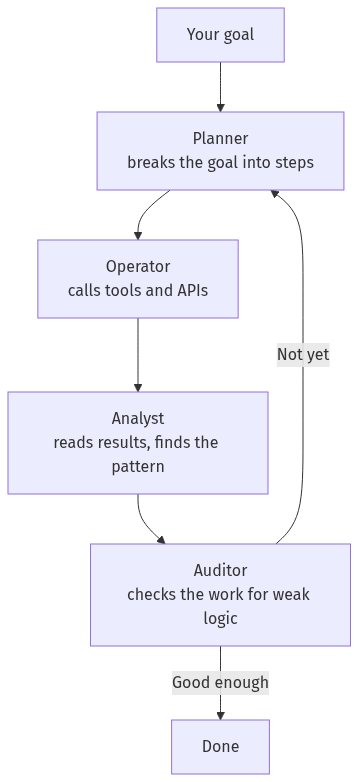
Take a real instruction. Every Monday at 7am, review last week’s support tickets, find the three biggest recurring issues, and email leadership a one-page brief.
The planner breaks that into steps. The operator pulls the tickets. The analyst spots the pattern that matters. The auditor checks the brief for sloppy logic before it goes out. You did not write the report. You handed the work of four people to one system.
How does tool use actually work?
This is the part that turns a language model into something useful. It is also simpler than the marketing makes it sound.
A language model cannot check today’s weather, query your database, or send an email. It only produces text. Tool use is the bridge between that text and the real world.
You hand the model a list of tools, each described in plain language. When it needs one, it does not run the tool itself. It outputs a structured request, usually JSON, that says “call this function with these inputs.” Your code runs the function and feeds the result back in.
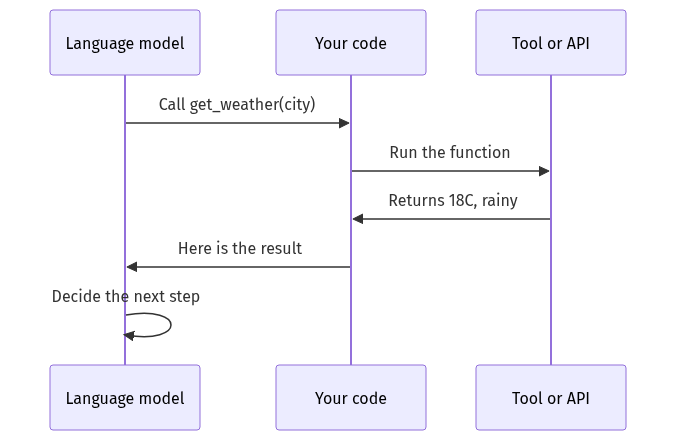
That back and forth is the entire mechanism. The model is the decision maker. Your code is the hands. People call it function calling, but the loop is the same: the model proposes, your runtime acts, the output goes back, and it repeats until the goal is met.
Why does the loop matter more than the model?
A real agent earns its name by what it does when the obvious path fails. That is the part the loop handles, and the model alone cannot.
There is a story I keep coming back to. In the 1970s, a colonel named John Boyd studied why American F-86 pilots in Korea kept beating faster Soviet jets that could climb higher. The faster jet should have won. It did not.
Boyd found that the American pilots could see more and adapt faster. They moved through their decision cycle before the enemy could react. He named that cycle OODA: observe, orient, decide, act.

An agent lives or dies by that same loop. Picture a script that every Friday checks grocery prices, builds your list, and places the order. It works until the week your usual item is sold out and six people are coming for dinner. The script breaks, because it was built to obey, not to think.
A real agent does something else. It sees the item is gone, finds a substitute, adjusts quantities for six, checks your calendar, notices the dinner, and rebuilds the order. A script follows the process. An agent reroutes it.
So when someone tells me they built an agent, I ask one question. When the first path breaks, can it find another way? If the answer is no, they built automation and put an agent label on it.
Where do AI agents break in production?
Here is the part the demos never show. The most dangerous trait of an agent is that it will do the wrong thing faster, and with more confidence, than any human on your team.
An agent is not magic. It is a multiplier. It reflects the quality of your thinking and amplifies it. Give it a vague goal and no way to check results, and it drives into the wall at full speed.
The data backs this up. Gartner polled more than 3,400 organizations and predicts that over 40 percent of agentic AI projects will be canceled by the end of 2027, mostly from unclear value and weak controls. In almost every failed project I have reviewed, the model was fine. The instructions were vague.
Before I let an agent near a real workflow, I run a check I call GPS.
- Goal. Can I state what I want in one clear sentence?
- Proof. Can I describe exactly what a good result looks like?
- Steps. Can I lay out each step without hand-waving?
If I cannot answer all three, the agent is not ready. Compare “summarize my emails” with “every morning at 7am, read unread emails, sort them by urgency, draft replies to routine ones, and flag anything from my top five customers.” The gap between those two is where production failures live.
The other failures are mechanical. Agents loop forever, calling the same tool because nothing tells them to stop. They blow past context limits and forget what they were doing. They also hallucinate confidently when a step lacks grounding. They chain five steps that are each 90 percent reliable, and the combined reliability quietly drops below half. None of this shows up in a five-minute demo. All of it shows up at 2am. This is exactly why I unit test agents instead of eyeballing them.
How should you start building with AI agents?
The winning move is not to build the broadest agent you can. It is to go narrow. The teams I see succeeding pick one workflow, one user, and one painful task, and they own it completely.
I watched a construction software company demo a single agent built to collect field data for one type of customer. The demo had a few glitches. It did not matter. When a QR code hit the screen, every hand in the room went up, because it solved a pain those people had lived with for years.
So here is the path I would take. Build the smallest useful agent you can. Give it one tool and one job, and structure its outputs so you can trust them (here is how I write agents with PydanticAI). Add the loop so it can react when a step fails. Cap how many times it can retry and how much it can spend. Log every decision so you can see why it acted.
Then, and only then, widen the scope. Judgment makes these systems work, not raw model power. You build that judgment one narrow problem at a time.
Frequently asked questions about AI agents
What is the difference between an AI agent and a chatbot?
A chatbot replies to each message and waits for the next one. An AI agent takes a goal, plans the steps, acts through tools, checks its own results, and adjusts when something fails. The underlying model can be identical. The difference is autonomy and the loop around it.
Do AI agents replace software engineers?
No. Agents change what engineers spend time on. They handle repetitive, well-defined tasks, so the valuable skill shifts toward defining problems precisely and judging whether the output is good. Engineers who use agents well will outpace those who do not.
What programming language is best for building AI agents?
Python is the practical default. The major frameworks, model SDKs, and data tooling all support it first. You can build agents in other languages, but you will spend more time fighting missing libraries than building your system.
Why do AI agents fail so often?
Most agent failures are human problems in disguise. The goal was vague, the definition of success was missing, or the steps were never made explicit. The model amplifies whatever you give it. Mechanical issues like infinite loops and context limits account for most of the rest.
The shift worth watching
For most of history, your income was tied to your hours. Even at the top, you traded time for decisions. Agents break that link. They do the work while you scale your judgment across the places it matters most.
When intelligence gets cheap, judgment gets expensive. The most valuable engineer is no longer the fastest typist. It is the one who can define good work, spot bad work, and know when to trust an agent and when to keep a human in the loop.
The way to get there is simple. Build something small, watch where it breaks, and learn from it. If you want the engineering details I share as I build these systems, follow along on LinkedIn or reach me through the contact page.
About the author
Ayaz Qaiser is a senior AI engineer with eight years of experience building machine learning systems in healthcare and finance. He has shipped a patient diagnostic platform, an AI financial analyst, and several LLM applications in production. He writes about how AI actually works once it leaves the demo and meets real users.