



The Junior Developer Crisis is Real: Here’s Your Survival Roadmap in an AI-First World
Let’s cut the noise and be real for a second: the entry-level software engineering market feels incredibly weird right now.
If you are a current Computer Science student, a recent bootcamp graduate, or a self-taught developer grinding through tutorials, you’ve probably felt the vibe shift over the last 18 months. The standard advice that industry veterans have been dispensing for a decade—build a portfolio, learn the MERN stack, push to GitHub, grind LeetCode, get hired—isn’t generating the same results it used to. Applications seem to disappear into a black hole, and entry-level postings are demanding three years of experience.
So, what’s happening?
It’s easy to blame the macroeconomic climate, interest rates, or post-pandemic overhiring corrections. While those are factors, ignoring the massive technological elephant in the room is naive.
AI has fundamentally broken the traditional value equation of a Junior Developer.
Tools like GitHub Copilot, Cursor, GPT-4o, and Claude 3.5 Sonnet haven’t just made coding faster; they have automated the primary function that junior engineers used to serve.
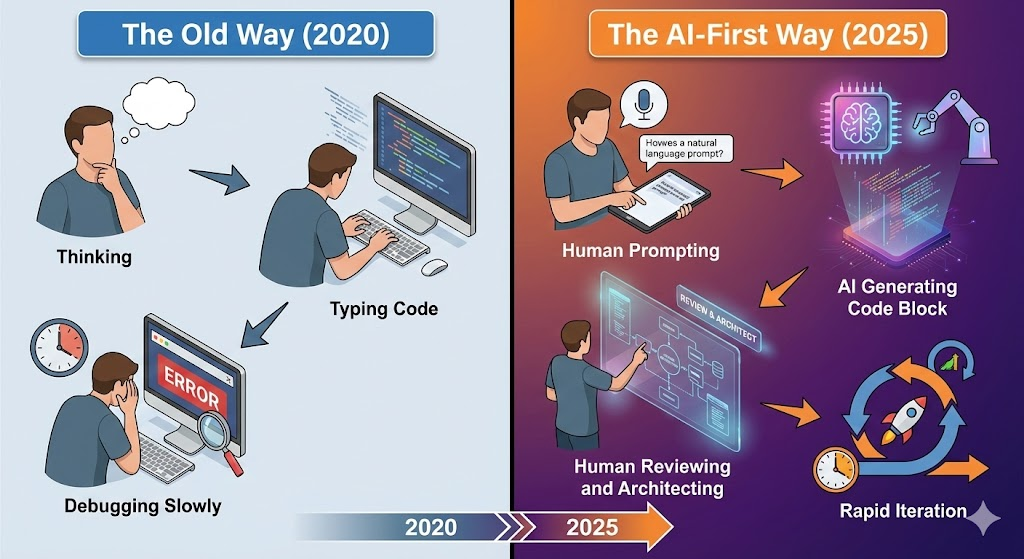
In the past, a senior engineer would design a system and hand off smaller, well-defined chunks of work to a junior. The junior’s job was essentially “translation work”—taking a human specification and translating it into valid syntax (Python, JavaScript, C#). It was honest work, and it was how you learned the ropes.
But in 2025? AI is the world’s fastest, cheapest, and most tireless translator.
If a senior engineer can prompt an LLM to generate the boilerplate for a microservice in 30 seconds, why would a company pay a junior engineer a full salary to take three days to do the same thing?
This sounds grim. You might be asking, “Is the Junior Developer role dead?”
No. But the old version of that role is absolutely dead. The bar has been raised significantly. The floor is gone. To survive the “Junior Crisis,” you need a radically different skillset than what was required even three years ago.
Here is your roadmap to adapting to an AI-first career.
The Death of the Syntax Monkey (And the Rise of the Architect)
This is the hardest pill to swallow for people currently in learning mode.
For decades, learning to code meant memorizing syntax. You were valuable if you knew the exact arguments for a complex array method in JavaScript or how to set up a Flask server from memory.
Today, writing syntax is a low-value commodity skill. If your primary value proposition is that you can type out a React component or write a SQL query from scratch, you are competing directly with a machine that has infinite memory, costs $20 a month, and never gets tired. You will lose that competition every time.
The Pivot: From Writer to Reviewer
You need to shift your identity from being a “writer of code” to an “architect and reviewer of solutions.”
AI models are incredibly impressive, but they are also confident liars. They hallucinate APIs that don’t exist. They introduce subtle security vulnerabilities. They choose O(n²) algorithms when O(n log n) is required because they saw a bad example somewhere in their training data.
In an AI-first world, the human’s primary job shifts to Verification and Orchestration.
- Don’t just learn how to write code; learn why it works. If Copilot spits out a complex Regular Expression, do you just blindly trust it? A modern junior needs to be able to dissect that regex, verify it covers edge cases, and ensure it won’t crash the production server on bad input.
- Cultivate “Taste.” AI can give you five different ways to solve a problem. The skilled engineer knows which one is maintainable, scalable, and fits the current architecture. That “taste” comes from understanding foundational principles, not just syntax.
Actionable Advice: Stop trying to memorize boilerplate. Instead, focus on patterns. When practicing, generate a solution with AI, and then spend 30 minutes actively trying to break it, refactor it for readability, or optimize its performance. Be the editor, not the writer.
Also Read:AI Browsers Are Becoming Development Tools
Reading Code is the New Writing Code
We used to tell juniors: “To get better, write code every day.”
The new reality is: “To get better, read code every day.”
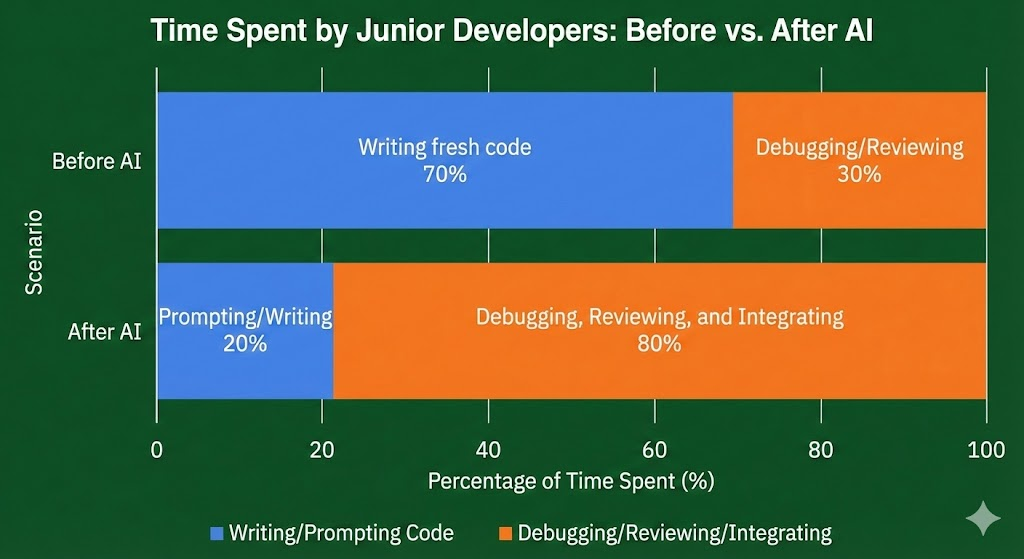
Here is the downstream effect of AI that few people are talking about: the sheer volume of code in existence is about to explode. Senior engineers are using these tools to become 10x more productive. They are shipping features faster, which means codebases are growing exponentially larger and more complex.
Who is going to maintain all that generated code?
The bottleneck in software engineering is shifting from generating new features to understanding and maintaining existing ones.
Deep Debugging Over Shallow Building
If you can parachute into a complex, unfamiliar, partially AI-generated codebase, figure out why it’s throwing an obscure error, and fix it without breaking everything else, you are infinitely more employable than someone who can only build a greenfield To-Do app from a tutorial.
- Master the Debugger: Console.log is fine, but it’s kid stuff. You need to deeply understand the debugging tools in VS Code or Chrome DevTools. Learn how to set breakpoints, step through execution stacks, and watch variables mutate in real-time.
- Read Documentation, Not Just Tutorials: AI is great at the “happy path”—the perfect scenario where everything works. It is terrible at edge cases. The answers to the hard problems aren’t in a Medium article; they are deep in the official documentation of the library you are using. Learn to read specs.
System Design is No Longer Just for Seniors
Traditionally, “System Design” was a gatekeeping interview topic reserved for Senior or Staff Engineer roles. Juniors were told to focus on functions, classes, and components—the micro level.
That gatekeeping is gone. Because AI handles the implementation details (the micro), juniors must understand the bigger picture (the macro) much earlier in their careers.
If you don’t understand how the pieces fit together, you cannot effectively prompt the AI to build the right thing, nor can you connect the blocks it generates.
The “Full Stack” Baseline
You don’t need to be able to design Netflix from scratch on day one. But the definition of “entry-level knowledge” has expanded to include the fundamental building blocks of modern architecture.
If you are applying for frontend roles, you still need to know:
- How does the browser actually render a page?
- What is an API, and what is the difference between REST and GraphQL?
- What happens when a request is slow? (Basic concepts of latency and asynchronous operations).
If you are applying for backend roles, you need to know:
- Basic database design (SQL vs. NoSQL relationships).
- Why do we need caching (e.g., Redis)?
- The very basics of cloud infrastructure (What is a serverless function? What is object storage like AWS S3?).
The AI advantage here: Use ChatGPT to teach you system design. Ask it: “Explain the concept of Load Balancing to me like I’m a junior react developer, and give me an analogy.” Use the tools to accelerate your learning of high-level concepts.
Also Read:How MCP Is About to Replace Traditional APIs
The Ultimate Moat: Human Domain Knowledge
If everyone has access to the same super-intelligent coding assistant, what becomes the differentiator?
Context.
AI models are sociopathic geniuses. They are incredibly smart but have zero empathy and zero context about your specific business, your users, or your team’s history. They will happily generate code that is technically correct but completely useless for the product you are trying to build.
The developers who are struggling right now treat coding as an abstract puzzle, separate from the real world. The developers who are succeeding are the ones who act as “Product Engineers.”
Be a Bridge, Not a Silo
Your value lies in bridging the gap between a fuzzy human business problem and a concrete technical solution.
- Understand the “Why”: Don’t just take a ticket from Jira and start coding. Ask why this feature is being built. Who is it for? What is the desired business outcome? If you understand the goal, you can nudge the AI in the right direction.
- Soft Skills are Hard Skills: Communication is harder now. You have to articulate complex technical ideas to humans (stakeholders, PMs) and highly specific technical instructions to LLMs (prompt engineering). Clear thinking leads to clear prompting.
If you can look at a product requirement, spot why it’s going to frustrate users, suggest a better alternative, and then use AI to build it quickly—you are irreplaceable.
Also Read:Magentic-UI vs Vercel AI UI vs Anthropic Tool Use UI: Which One Should You Use?
The Verdict: Evolve or Get Left Behind
I know this might sound overwhelming. It feels like the goalposts just got moved five miles down the field just as you were getting ready to kick.
And yeah, they did. The “easy” entry-level jobs where you could coast on basic HTML/CSS knowledge are evaporating. The market is filtering out those who only know how to code, leaving only those who know what to code and why.
But this isn’t the end of the road for junior developers. It’s an evolution.
Think about it: the barrier to creation has never been lower. You can build things this weekend that would have taken a team of five people three months to build in 2015.
The juniors who adapt—who stop fearing AI and start using it as a massive force multiplier, who focus on high-level problem solving over low-level syntax—are going to build cooler, bigger, and more impactful software faster than any generation before them.
Stop trying to compete with the robot. Start managing it.